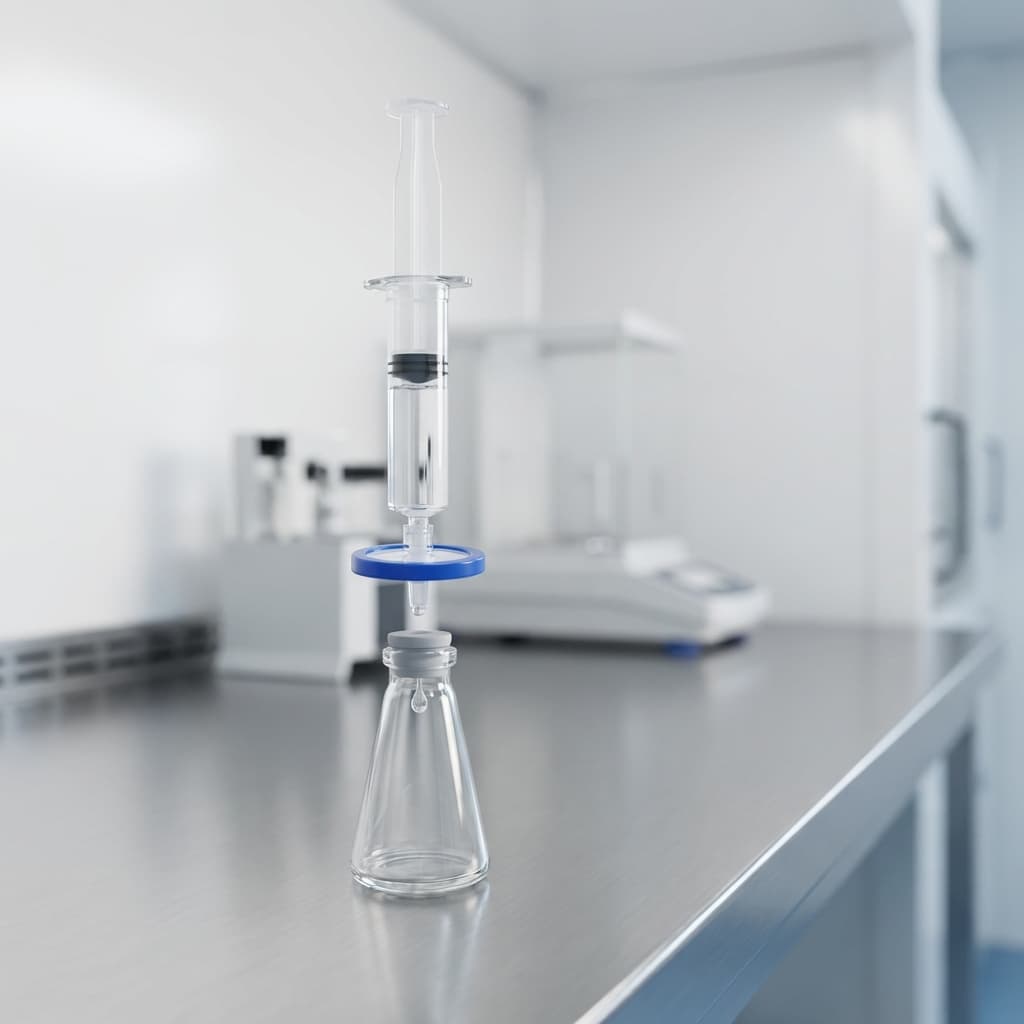
Sterile filtration is the process of physically removing microbial contaminants from a research solution using a 0.22 micron (µm) membrane. This is mandatory when reconstituting with plain sterile water or custom buffers lacking preservative systems.
☢️ The "Nylon Trap"
Never use Nylon filters for peptide solutions. Nylon has a massive electrostatic affinity for peptide chains, and can "strip" up to 40% of your compound out of solution, leaving it trapped in the membrane.
Choosing the correct membrane material (media) is critical for ensuring the quantitative purity of the filtrate.
Polyethersulfone (PES)
Gold Standard. The lowest possible protein/peptide binding. Ideal for almost all research applications.
PVDF (Hydrophilic)
Secondary Option. Low binding, but requires pre-wetting. Ensure it is explicitly marked "Hydrophilic."
When filtering small research volumes (1-5mL), the amount of liquid trapped inside the filter housing (the "dead volume") becomes a significant source of error.
📏 Filtration Loss (Hold-up) Calculator
✅ Efficient filtration ratio.
Follow the "Luer-Lock Mandate" to prevent pressure-vessel failure during filtration.
- Assembly: Attach a PES syringe filter to a Luer-Lock syringe. Slip-tip syringes can pop off under pressure, aerosolizing the research compound.
- Priming: Push 0.1mL of solution through the filter and discard. This "saturates" any minor binding sites on the membrane.
- The "Steady Push": Apply constant, slow pressure to the plunger. If the filter resists, do not force it—particulates have clogged the pores.
- Air Purge: Once the liquid is gone, pull 1mL of air into the syringe and push it through the filter to recover the final droplets trapped in the membrane.
💡 Pro-Tip: Sequential Filtration
For cloudy solutions that won't pass a 0.22µm filter, pre-filter with a 0.45µm or 1.0µm glass fiber filter first to remove large aggregates.
Supplies Checklist
- 0.22µm PES Syringe Filter
- Luer-Lock Sterile Syringe
- Sterile Receiving Vial
- Sterile Transfer Needle